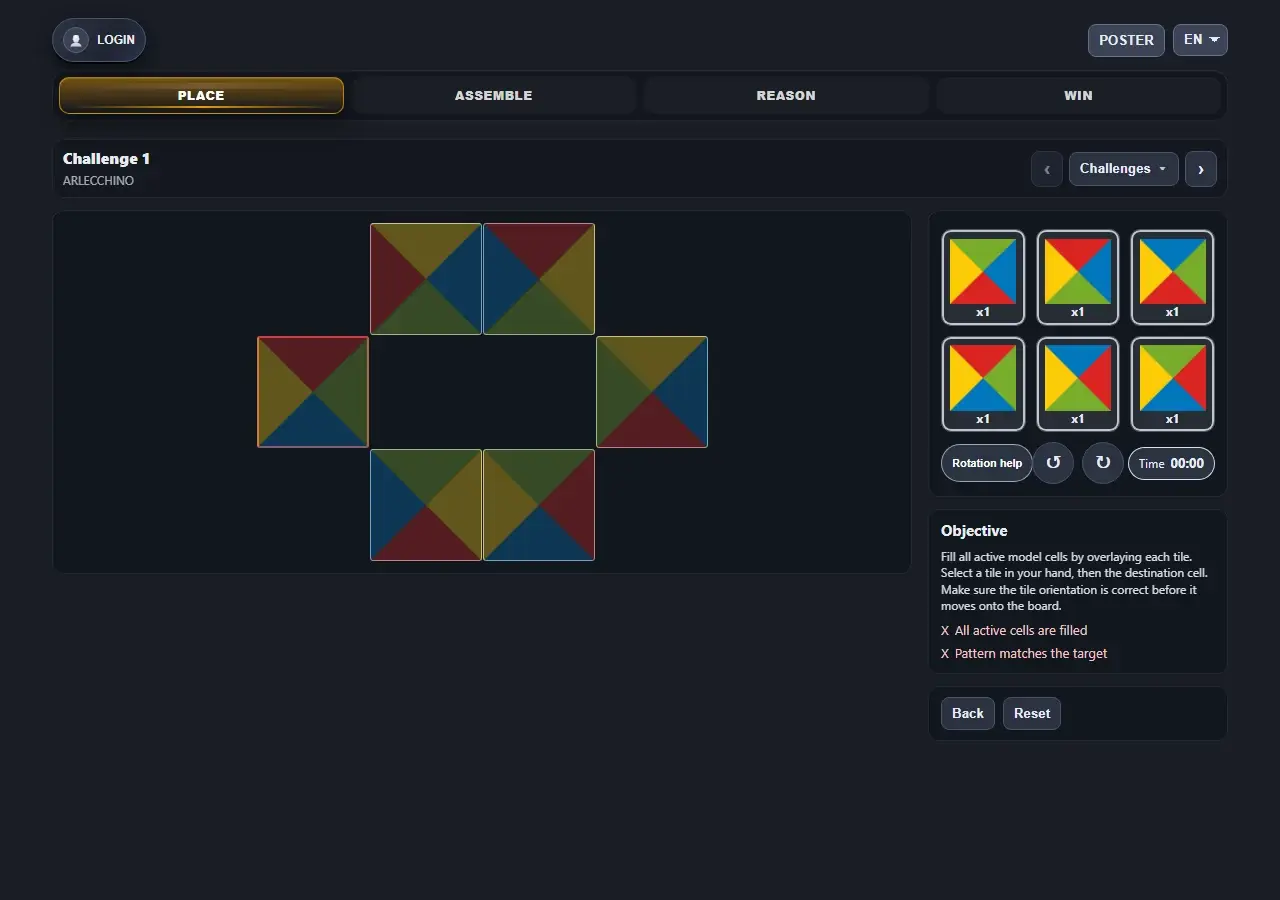
Place
Find where to place the pieces while following the given constraints.
10 in the historical inventoryRULES AND CHALLENGES
Think on your own, compare ideas, play together: each format has its own rules. With the POSTER, start with solo puzzles, then move on to strategy for 2–4 players using the same tiles.
Each tile is a square divided into four coloured triangles. To join tiles, bring matching colours together. This simple gesture opens up different possibilities: building a shape, solving a puzzle or choosing a move in a game.
Before a game, choose the instructions for your edition.
Mix the 25 pieces and rebuild your chosen artwork.
Turn the 25 pieces over and place them back on the board: match the colours on every adjoining side, including where the pieces meet the board’s edges.
Choose your colours and create more squares than your opponents. On each turn, rotate a piece and place it so that every adjoining colour matches.
Place the centre piece in the middle of the board. Divide the other 24 pieces between the players.
Play a piece from your hand if a legal placement is available. Otherwise, pass your turn.
Turn the piece in quarter turns to prepare your move.
Choose an empty cell next to a piece already on the board. Every colour in contact must match.
Two adjoining triangles of the same colour form a monochrome square. Each square scores one point for the player of that colour, even if someone else created it. One move can create several squares.
Two sides of the same colour facing an empty cell can make it unplayable: each piece has each colour only once.
The game ends when no player can place another piece, even if empty cells remain. The player or team with the most squares in their colour or colours wins.
Open the POSTER rules pageFind this edition’s setup, distribution of pieces and instructions on its product page.
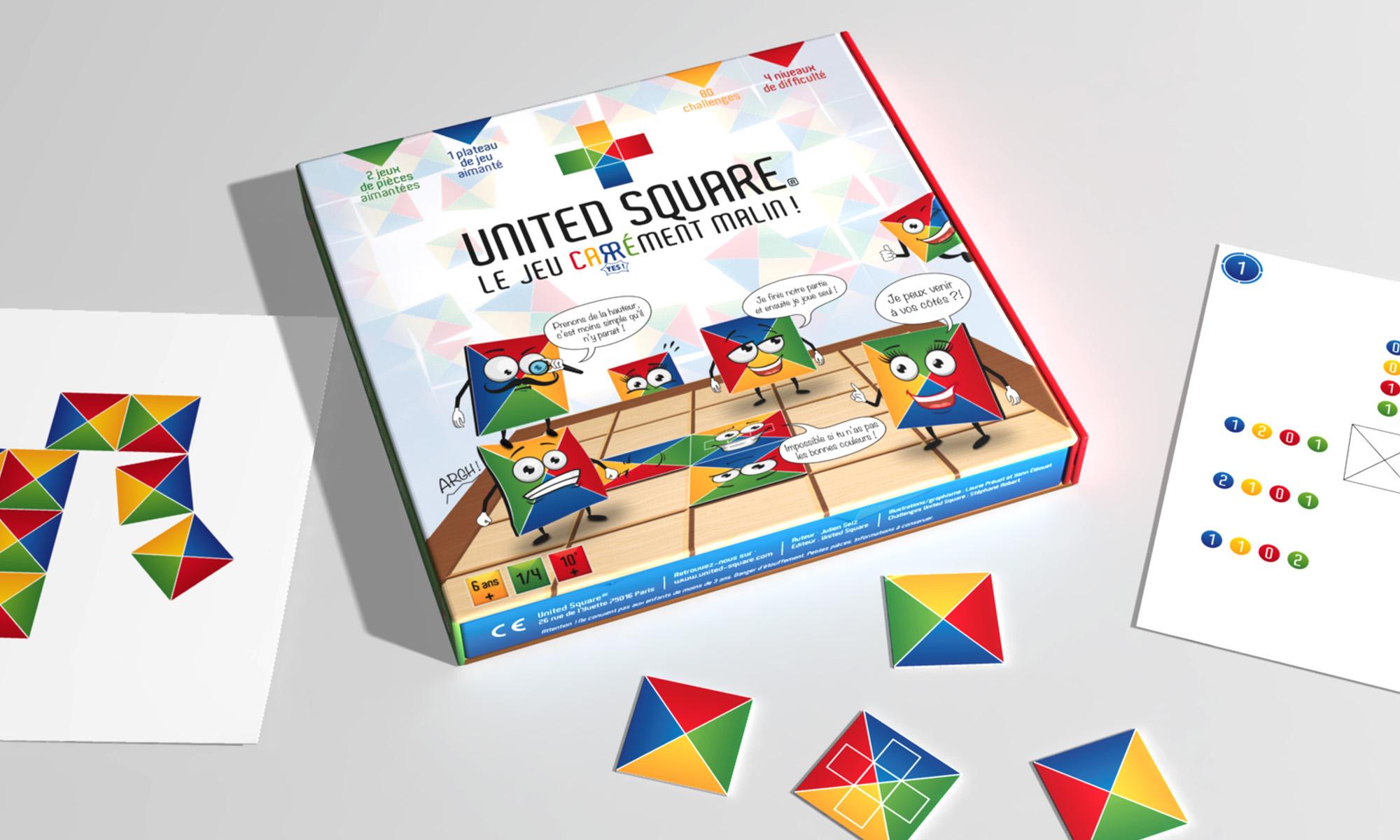
Read the magnetic edition rulesThe illustrated magnetic box states 80 challenges. The historical “Play” page describes a different inventory: 73 challenges across four families. Each figure belongs to its source; neither guarantees identical contents across all editions.
Source: rules from the historical UNITED SQUARE website, preserved in the archive.
Find where to place the pieces while following the given constraints.
10 in the historical inventoryJoin pieces to build the required shape.
24 in the historical inventoryExamine the clues, compare possibilities and work out a solution.
16 in the historical inventoryFind a placement that meets a game objective.
23 in the historical inventoryPLAY offers the Place, Assemble, Reason and Win families. On-screen challenges have their own equipment and instructions: the printed inventory does not automatically describe the digital catalogue.
Open PLAY to choose from its existing activities. The instructions displayed in each challenge apply to that activity.
Explore PLAY